BURIED TOGETHER
Partner John Stephen
Queer Places:
University of Cambridge, 4 Mill Ln, Cambridge CB2 1RZ
St. Mary's Churchyard, Station Rd, Ballaugh, Michael IM7 5AQ Isle of Man
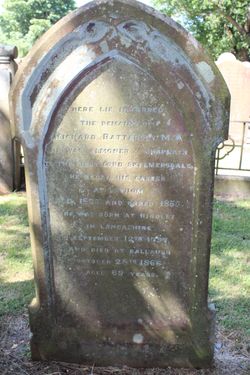 Richard Battersby (September 12, 1797 – October 28, 1866) was born on September 12, 1797, in Hindley, located in the Metropolitan Borough of Wigan, Greater Manchester,
England, as the son of Richard and Sarah Battersby (née Worsley). He pursued his higher education at St John's College, Cambridge, where he was admitted as a pensioner on
April 29, 1818, matriculating in October 1818. During his time at Cambridge, he became a founding member of the prestigious intellectual secret society the
Cambridge Apostles, before eventually graduating with a Bachelor of Arts (BA) in 1822 and a Master of Arts (MA) in 1827.
Richard Battersby (September 12, 1797 – October 28, 1866) was born on September 12, 1797, in Hindley, located in the Metropolitan Borough of Wigan, Greater Manchester,
England, as the son of Richard and Sarah Battersby (née Worsley). He pursued his higher education at St John's College, Cambridge, where he was admitted as a pensioner on
April 29, 1818, matriculating in October 1818. During his time at Cambridge, he became a founding member of the prestigious intellectual secret society the
Cambridge Apostles, before eventually graduating with a Bachelor of Arts (BA) in 1822 and a Master of Arts (MA) in 1827.
Following his graduation, Battersby entered the clergy, being ordained as a deacon in 1822 and as a priest in Hereford on August 3, 1823. His ecclesiastical career became
primarily defined by a long-standing domestic appointment when he assumed the role of domestic chaplain and almoner to Edward Bootle-Wilbraham, 1st Baron Skelmersdale,
serving in this capacity from 1825 until 1855 at Lathom in Lancashire. During the 1851 census, he was recorded as residing in Lathom, accompanied by one male lodger and two
female servants. Having concluded his tenure with Lord Skelmersdale in 1855, he held no further ecclesiastical cures for the remainder of his life.
In his later years, Battersby relocated to the Isle of Man, settling late of Ballamoar in Ballaugh. He passed away on October 28, 1866, at the age of 69, and was interred
at St Mary's Churchyard in Ballaugh. His probate was granted to John Stephen, an Esquire buried near him. His memorial inscription records his tenure as chaplain and
almoner, commemorating his life spanning from his birth in Hindley to his death on the Isle of Man. Regarding historical records of potential LGBTQ links, standard
biographical archives, university alumni records, and ecclesiastical registers do not document any specific relationships or affiliations of an LGBTQ nature concerning
him.
References:
Other references:
- Alumni and University Records: St John's College admissions records (adm. 1818:04:29), Cambridge matriculation records (1818:10MT), and graduation records (BA 1822, MA 1827).
- Ecclesiastical and Clerical Records: Ordination records (deacon 1822; priest in Hereford on August 3, 1823) and records detailing his tenure as Domestic Chaplain and Almoner to Lord Skelmersdale (1825–1855).
- Gentleman's Magazine (G. Mag. 1866, Vol. II, p. 842).
- Research notes and compilations by F.P. White regarding the Cambridge Apostles.
- Census and Civil Registration Records: The 1851 Census (recording his residence in Lathom, Lancashire).
- Birth and christening records (Hindley, Lancashire, September 12, 1797; son of Richard and Sarah Worsley Battersby).
- Death and burial records (St. Mary's Churchyard, Ballaugh, Isle of Man, October 28, 1866).
- Memorial inscription at St. Mary's Churchyard, Ballaugh.
- Probate records naming John Stephen, Esquire.
Support this project
This website is a passion project researched, developed, and funded entirely by me. If you find the content valuable and would like to help support the ongoing research and hosting costs, any contribution is deeply appreciated.
Thank you for keeping this independent resource alive!
My books on Amazon: Elisa Rolle's books
BACK TO HOME PAGE
